




Allways Atascosa Dodge Chrysler Jeep Ram

Blog / Allways Atascosa Dodge Chrysler Jeep Ram Service

Complete 2026 Ram 2500 Maintenance Schedule: Expert Q&A with Allways Atascosa CDJR

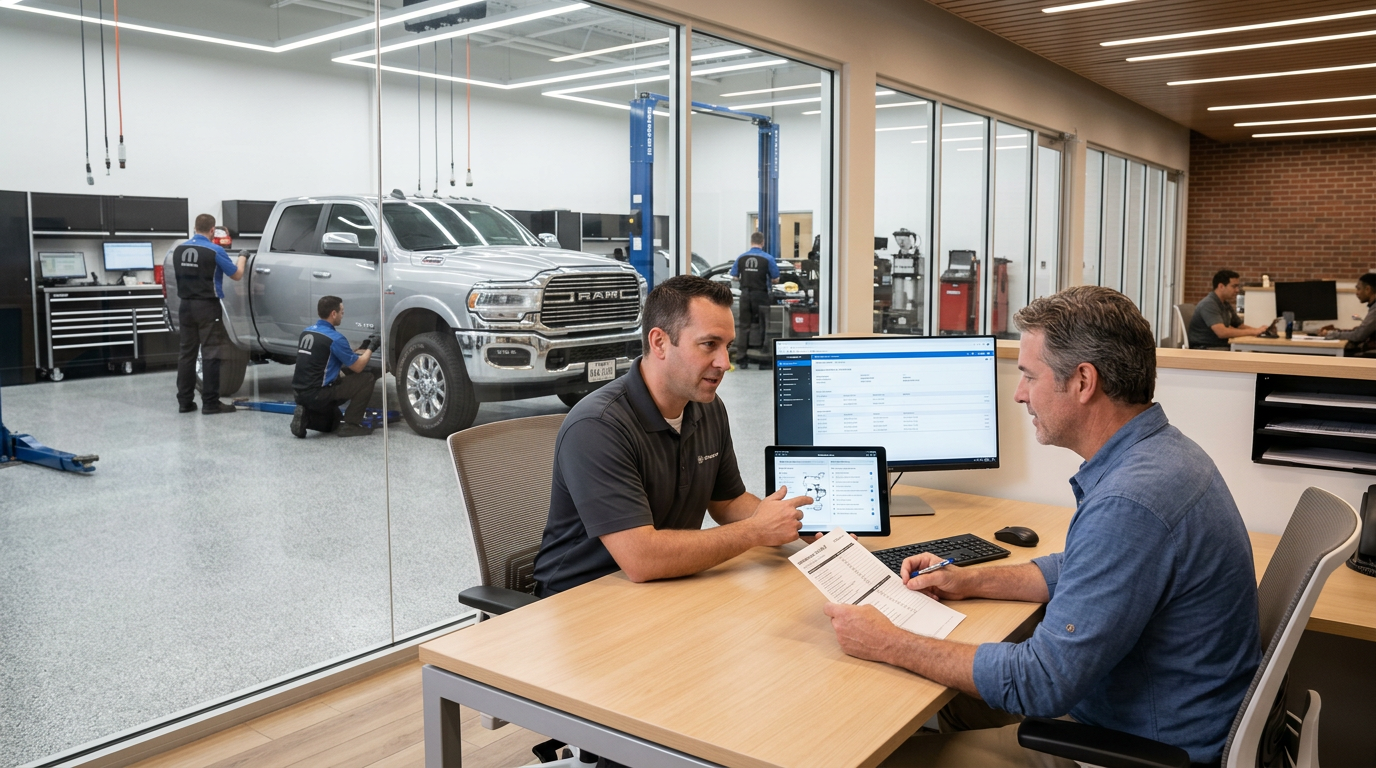
A service advisor uses a tablet to explain vehicle repairs to a customer at a desk next to a service bay. (Representative image for illustration purposes only. Actual vehicle may vary based on trim and configuration.)

We recently sat down with Mike Vasquez, our Service Manager at Allways Atascosa CDJR, to discuss the routine care required for heavy-duty trucks. With 25 years of experience keeping commercial fleets and personal workhorses on the road, Mike walks us through the complete maintenance schedule for the 2026 Ram 2500.

Q: How often should you change the oil in a 2026 Ram 2500 6.4L HEMI V8?

A: Maintaining the health of a heavy-duty engine requires keeping a close eye on the oil life monitor. For the 6.4L HEMI V8 gas engine, the condition-based Oil Change Indicator system typically calls for an oil and filter change between 3,500 and 8,000 miles . Under normal operating conditions, you should never exceed 8,000 miles or 12 months between services to prevent oil breakdown and engine wear . Ranchers in Pleasanton who spend their days hauling stock trailers across open South Texas pastures will typically see their oil life indicator drop faster due to high dust and heavy engine loads.

If you want to keep your truck running at peak performance, we recommend utilizing our express service lane for routine maintenance. Our certified technicians will ensure your engine gets the exact oil grade it needs to handle extreme heat. You can easily book your next service appointment online or go ahead and schedule your oil change today to stay ahead of schedule. If you are shopping for a dependable truck, you can also browse our latest new Ram inventory or check out our pre-owned Ram inventory. To learn more about how we support our customers, discover the perks of our customer appreciation program. For any questions, give our service team a quick call at (830) 281-2244 or stop by our dealership at 110128 Interstate Hwy, 37 N, Pleasanton, TX 78064.

Q: What are the engine options and towing capacities for the 2026 Ram 2500?

A: The powertrain lineup for this heavy-duty pickup consists of two highly capable engines designed for serious work. The standard option is the 6.4L HEMI V8 gasoline engine, which delivers 410 hp and 429 lb-ft of torque. For drivers who require maximum pulling power, the optional 6.7L Cummins Turbo Diesel inline-six engine produces 430 hp and an incredible 1,075 lb-ft of torque.

When it comes to capability, a properly equipped diesel model features a maximum towing capacity of up to 20,000 pounds, making it ideal for pulling massive trailers. If you opt for the gasoline engine, you benefit from a higher maximum payload capacity of 4,420 pounds, which is perfect for carrying heavy equipment in the bed. To find the right configuration for your specific needs, you can explore our diverse used vehicle inventory or take advantage of current manufacturer information. While we love heavy-duty trucks, we also offer a complete selection of new Jeep vehicles for those seeking weekend adventure.

Q: Which truck has a higher towing capacity: 2026 Ram 2500 or Ford F-250?

A: While the Ford F-250 Super Duty boasts a higher maximum towing capacity of up to 23,000 pounds when properly equipped, the Ram 2500 remains a favorite for its unmatched ride quality and premium cabin comfort. The Ram 2500 caps its towing capacity at 20,000 pounds with the diesel engine, which is more than enough for the vast majority of heavy-duty tasks. What sets the Ram apart is its exclusive coil-spring rear suspension and optional air suspension, which prevent the harsh, bouncy ride typical of traditional leaf-spring setups.

Furthermore, the interior features premium materials and advanced technology, including an available 14.5-inch touchscreen running the latest Uconnect software. If you want to experience this refinement firsthand, feel free to get in touch with our friendly dealership staff. You can also browse our certified one-owner pre-owned vehicles to find a high-quality truck with a documented history, and make sure to view our latest service and parts coupons to save on your next visit.

"A heavy-duty truck is only as reliable as the maintenance it receives, especially when you are putting it to work under the demanding South Texas sun."

Q: How much does a 2026 Ram 2500 cost across its different trim levels?

A: The pricing structure for this heavy-duty truck spans a wide range to accommodate both fleet buyers and luxury seekers. The entry-level Tradesman starts at $50,475 MSRP for the Crew Cab short bed configuration, offering a rugged and straightforward work truck. Moving up the lineup, the popular Laramie starts at $62,310 MSRP, bringing an excellent balance of leather-trimmed comfort and advanced tech.

For those who want ultimate luxury, the top-tier Limited trim starts at $74,610 MSRP and can reach $77,540 MSRP when equipped with four-wheel drive. Off-road enthusiasts can look toward the rugged Rebel starting at $69,755 MSRP or the legendary Power Wagon starting at $73,250 MSRP. To make your upgrade more affordable, be sure to estimate your trade-in value online and view our current new vehicle inventory. You can also learn more about our dealership history and mission to see why so many local drivers trust us with their automotive needs.

Q: How often should the brake system be inspected on a 2026 Ram 2500?

A: When I am walking heavy-duty truck owners through their service plans, I always emphasize that stopping power is just as crucial as towing power. Under normal driving conditions, the brake system should be thoroughly inspected every 10,000 to 15,000 miles or during every tire rotation . Families in Boerne who regularly tow heavy travel trailers up and down the steep limestone slopes of the Texas Hill Country need to pay extra attention to their brakes.

Towing down long descents puts immense thermal stress on the brake pads and rotors, which can accelerate wear and lead to brake fade. Every new model comes backed by a 3 years / 36,000 miles basic warranty and a 10 years / 100,000 miles drivetrain warranty, giving you peace of mind on the road. If you ever experience a breakdown or need emergency assistance, you can rely on Chrysler, Dodge, Jeep, Ram Roadside Assistance: 1-800-521-2779 for manufacturer-backed support.

When you are ready to purchase, you can apply for financing online today or  contact our finance team for current financing information. Local business owners can also discover the benefits of our commercial vehicle program to keep their fleet running safely. Our team specializes in tailoring solutions that protect your commercial investments while keeping operating costs predictable.

Q: What are the exact transmission fluid change mileages for a 2026 Ram 2500 diesel?

A: Drivetrain lubrication is the lifeblood of any heavy-duty truck that regularly pulls heavy loads. For models equipped with the diesel engine and the robust automatic transmission, the manufacturer recommends changing the transmission fluid and 4x4 transfer case fluid every 60,000 miles . Under severe use, such as continuous commercial towing, this interval should be shortened to keep the gears properly cooled and lubricated .

In addition to the transmission, the front and rear axles require regular inspection, with axle fluid replacements typically scheduled around 120,000 miles under normal use . Keeping up with these fluid changes prevents premature wear on the internal components of the 8-speed automatic system. To help cover the costs of these critical services, you can review our local vehicle financing solutions or take a moment to get prequalified online. You can also protect your truck's exterior and interior from the elements by choosing to explore our appearance protection options.

Q: How should I adjust the maintenance schedule for severe duty use on a 2026 Ram 2500?

A: Operating a heavy-duty truck in harsh environments requires a more proactive approach to routine maintenance. If your truck is subjected to severe duty—such as frequent trailer towing, heavy payloads, repeated short trips, or dusty off-road driving—you should adjust your service intervals accordingly. For gasoline models, we recommend performing oil changes closer to every 3,500 to 5,000 miles to protect the engine from thermal breakdown.

For diesel models, the oil life monitor will automatically adjust, but you must never exceed 15,000 miles, 12 months or 500 engine hours between changes . Additionally, the dual engine-mounted fuel filters must be replaced every 15,000 miles to protect the high-pressure fuel system from contamination . Other critical severe-duty milestones include replacing the engine coolant at 150,000 miles or 10 years and flushing the power steering fluid at 97,500 miles .

To schedule your next severe-duty service, visit our physical service department or speak with our service advisors by calling (830) 281-2244. If you are looking to expand your business fleet, you can also browse our commercial heavy-duty inventory to find the perfect work truck. We are fully equipped to handle fleet maintenance and individual heavy-duty service needs with minimal downtime.


© 2026 Allways Atascosa CDJR. All rights reserved.
Posted in:

Related Posts

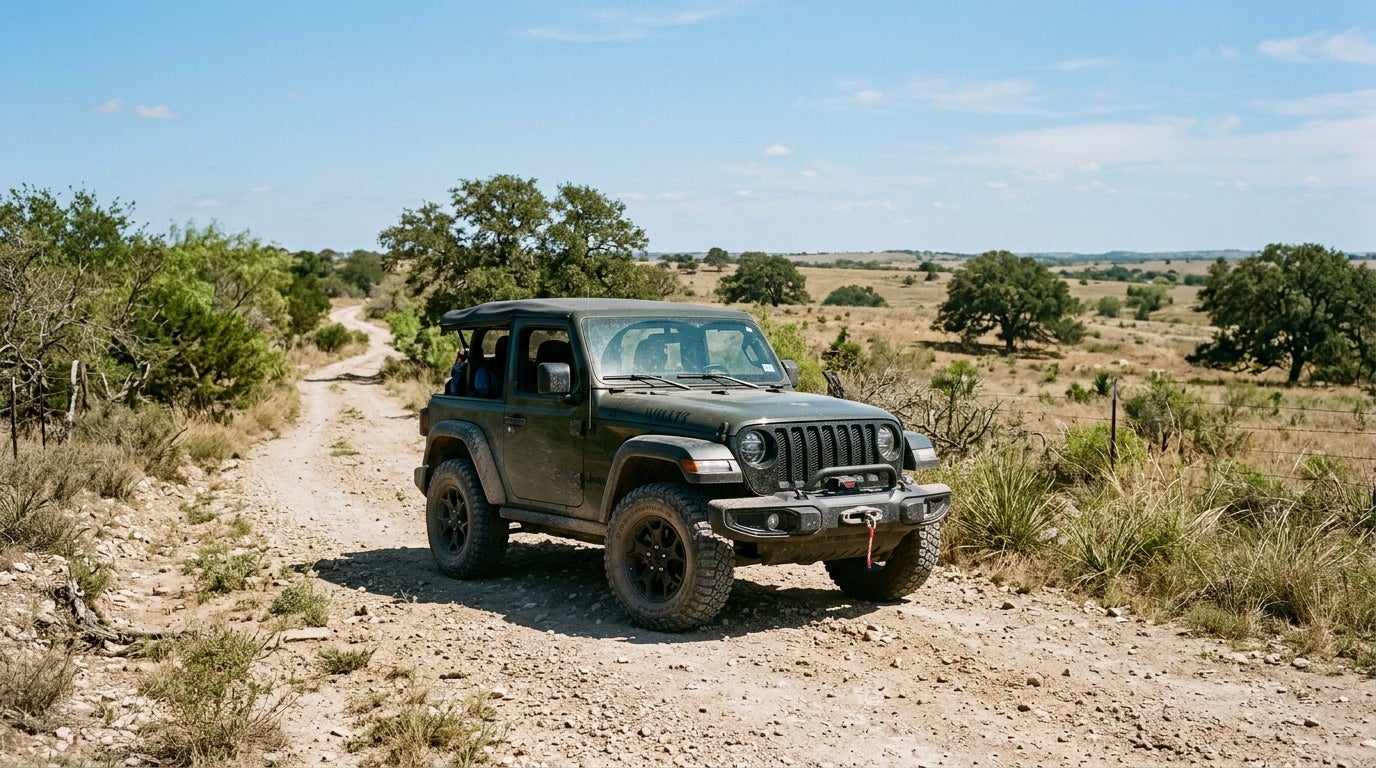
An olive green Jeep Wrangler parked on a rugged dirt road in a grassy countryside. (Representative image for illustration purposes only. Actual vehicle may vary based on trim and configuration.)

Jeep Wrangler Transmission Care & Service Intervals: Expert Q&A

Under normal highway operation, Jeep Wrangler transmission fluid requires inspection every 30,000 miles, but severe usage like off-roading, heavy trailering, or extreme South Texas heat requires fluid and filter replacement every 60,000 miles. Addressing early warning signs—including delayed gear engagement, slipping between ratios, fluid leaks, or an illuminated transmission temperature warning light—prevents complete mechanical failure. We sat down with Jesse Padilla, Service Manager at Allways Atascosa CDJR, who brings 20 years of professional automotive experience to explain how proper maintenance keeps these iconic 4x4 vehicles performing reliably on and off the road. Jeep Wrangler Transmission Service Intervals and Common Issue Warning Signs Q: Jesse, why is proper transmission maintenance so critical for Wrangler owners, and what basic service schedule should they follow? A: Jesse explains that Wrangler transmissions undergo significantly more mechanical strain than standard commuter vehicles due to four-wheel-drive demands, heavy payloads, and trail use. Under typical everyday driving, checking fluid clarity and levels every 30,000 miles keeps systems operating smoothly until a major service near 100,000 miles. However, driving across rough ranch terrain around Pleasanton or hauling equipment alters that timeline. Severe duty causes rapid fluid thermal degradation, making a complete fluid and filter replacement necessary at 60,000 miles. Owners can visit our service center location or schedule routine maintenance online to keep their driveline protected. Table of Contents What Transmissions Are Available in the 2024 Jeep Wrangler Lineup? Which Jeep Wrangler Transmission Performs Best for Rock Crawling and Off-Road Driving? What Symptoms and Warning Lights Indicate Transmission Problems in a Jeep Wrangler? What Is the Recommended Transmission Fluid Change Interval for a 2024 Jeep Wrangler Under Heavy Use? How Much Does a Transmission Fluid Service Cost, and Does Off-Roading Void Your Factory Warranty? What Transmissions Are Available in the 2024 Jeep Wrangler Lineup? Q: What transmission options does Jeep offer across the 2024 Wrangler powertrain lineup? A: Jesse notes that the 2024 lineup pairs distinct gearboxes to specific engine configurations to match driver preferences. A standard 6-speed manual transmission comes paired with the 3.6-liter V6 engine producing 285 horsepower and 260 lb-ft of torque, offering traditional mechanical engagement for three-pedal enthusiasts. Meanwhile, the available TorqueFlite 8-speed automatic transmission expands across all engine choices, including the 2.0-liter turbocharged inline-four pushing 270 horsepower and 295 lb-ft of torque, as well as the high-performance 6.4-liter V8 in the Rubicon 392 generating 470 horsepower and 470 lb-ft of torque using the heavy-duty TorqueFlite 8HP75 eight-speed automatic transmission. For plug-in hybrid models, the 4xe trim utilizes a specialized TorqueFlite 8F35P 8-speed automatic transmission that integrates an electric motor-generator directly into the transmission housing in place of a standard torque converter. This hybrid setup combines with the 2.0-liter turbocharged engine to deliver 375 total horsepower and 470 lb-ft of torque while achieving an EPA-estimated 49 MPGe and 22 miles of electric-only range. On models fitted with the Dana 44 HD full-float solid rear axle and 4.10 axle gears, selecting the automatic transmission enables a best-in-class 5,000-pound tow rating. Which Jeep Wrangler Transmission Performs Best for Rock Crawling and Off-Road Driving? Q: Which transmission option performs better when navigating low-speed rock crawls and technical off-road obstacles? A: Jesse highlights that while manual gearboxes offer nostalgic control, the TorqueFlite 8-speed automatic transmission stands out as the superior choice for technical rock crawling. The automatic transmission relies on a hydraulic torque converter that provides continuous power delivery to all four wheels without risk of engine stalling or gear roll-back on steep inclines. Off-roaders climbing rocky ledges and steep inclines around Boerne benefit immensely from this uninterrupted torque flow, which allows precise brake-throttling without burning through a manual clutch disk. "An automatic transmission acts like an extra foot on the brake when you are balancing on a ledge, giving you total throttle control without roll-back." In addition, automatic models seamlessly integrate with factory crawl ratios and transfer case low ranges, including axle ratios ranging from 3.45:1 up to 4.56:1 or the optional 4.88:1 factory gears available on the Rubicon X. When negotiating challenging terrain, driver-assist features and trail tech like the Uconnect 5 system with its integrated Trails Offroad mapping software allow drivers to focus on tire placement rather than manual clutch modulation. What Symptoms and Warning Lights Indicate Transmission Problems in a Jeep Wrangler? Q: What physical symptoms and dashboard warning lights should alert drivers to an impending transmission issue? A: Jesse points out that early warning signals often manifest physically long before complete driveline failure occurs. Common physical symptoms include harsh or delayed gear engagement when shifting into drive or reverse, hesitation during acceleration, gear slipping where engine revs flare without speed increase, and unusual clunking or whining noises coming from under the cabin floorboards. Reddish fluid spots under the vehicle indicate a leak from pan gaskets, cooler lines, or output seals, which quickly leads to hydraulic pressure loss if left unchecked. On the instrument cluster, a dedicated red transmission temperature light indicates internal fluid overheating, which commonly occurs during prolonged heavy towing or low-speed mud churning in summer heat. A check engine light accompanied by stored diagnostic trouble codes also flags solenoid malfunctions or gear ratio mismatches. Continuing to drive while these warning indicators are lit risks severe thermal damage to internal friction plates and planetary gear sets. What Is the Recommended Transmission Fluid Change Interval for a 2024 Jeep Wrangler Under Heavy Use? Q: How should maintenance schedules adapt for vehicles exposed to frequent off-roading, heavy towing, or high temperatures? A: Jesse explains that standard factory maintenance guides recommend inspecting transmission fluid every 30,000 miles and replacing it around 100,000 miles under ideal highway conditions. However, off-roading, trailering, or driving in sustained South Texas summer heat qualifies as severe duty. High ambient temperatures degrade synthetic transmission fluid, breaking down vital friction modifiers and anti-wear additives needed to protect planetary gears and clutch packs. Under severe operating conditions, replacing the transmission fluid and filter every 60,000 miles is essential for long-term driveline durability. Inspecting fluid health during every engine oil service ensures that water contamination—which can enter through vent tubes during deep water crossings up to the vehicle's 34-inch water fording limit—is caught immediately before rust or corrosion damages internal valve bodies. How Much Does a Transmission Fluid Service Cost, and Does Off-Roading Void Your Factory Warranty? Q: What is the typical cost for a transmission fluid service, and does taking a Wrangler on off-road trails void its warranty? A: Jesse clarifies that a professional transmission fluid service and filter replacement typically ranges between $300 and $550, depending on fluid volume and shop labor rates. Using genuine Mopar fluid engineered specifically for TorqueFlite gearboxes ensures proper hydraulic pressures and shift quality. Owners can check current service pricing or give our service department (830) 281-2244 a call to confirm pricing and maintenance scheduling. Regarding factory warranty coverage, operating a Wrangler off-road in normal, non-abusive conditions does not void the 3-year/36,000-mile limited warranty or the 5-year/60,000-mile powertrain warranty. However, damage resulting from extreme mechanical abuse, water ingestion from exceeding water-fording limits, or unapproved aftermarket suspension modifications that strain driveshaft angles can result in denied warranty claims. Sticking to recommended service intervals and having repairs completed by factory-trained technicians ensures your factory coverage remains fully intact. © 2026 Allways Atascosa CDJR. All rights reserved. { "@context": "https://schema.org", "@graph": [ { "@type": "NewsArticle", "@id": "#article", "headline": "Jeep Wrangler Transmission Care & Service Intervals: Expert Q&A", "datePublished": "2026-09-18T01:15:29.754Z", "dateModified": "2026-09-18T01:17:27.734Z", "author": { "@id": "#author" }, "publisher": { "@id": "#dealer" }, "wordCount": 1227, "description": "Learn essential Jeep Wrangler transmission service intervals, severe-duty fluid change schedules, and early warning signs of mechanical issues." }, { "@type": "AutoDealer", "@id": "#dealer", "name": "Allways Atascosa CDJR", "description": "Allways Atascosa Dodge Chrysler Jeep Ram, where we Allways treat you like family.", "url": "https://www.atascosacdj.com", "telephone": "+18302812244", "sameAs": [ "https://www.facebook.com/atascosacdjr", "https://www.instagram.com/allwaysatascosacdjr/", "https://www.youtube.com/@atascosacdj", "https://maps.apple/p/ePJKtWw5L6.b86", "https://www.yelp.com/biz/allways-atascosa-chrysler-dodge-jeep-ram-pleasanton-3?osq=allways+atascosa+cdjr", "https://www.dealerrater.com/dealer/Allways-Atascosa-CDJR-review-21466/", "https://www.cargurus.com/Cars/m-Atascosa-Chrysler-Dodge-Jeep-sp63223", "https://www.carfax.com/Reviews-Atascosa-Chrysler-Dodge-Jeep-Pleasanton-TX_F60X0Q8WO1", "https://maps.google.com/?cid=6181620104188588384" ], "address": { "@type": "PostalAddress", "streetAddress": "110128 Interstate Hwy", "addressLocality": "Pleasanton", "addressRegion": "TX", "postalCode": "78064", "addressCountry": "US" }, "openingHours": [ "Mo 08:30-19:00", "Tu 08:30-19:00", "We 08:30-19:00", "Th 08:30-19:00", "Fr 08:30-19:00", "Sa 09:00-15:00" ] }, { "@type": "FAQPage", "@id": "#faq", "mainEntity": [ { "@type": "Question", "name": "Jesse, why is proper transmission maintenance so critical for Wrangler owners, and what basic service schedule should they follow?", "acceptedAnswer": { "@type": "Answer", "text": "Jesse explains that Wrangler transmissions undergo significantly more mechanical strain than standard commuter vehicles due to four-wheel-drive demands, heavy payloads, and trail use. Under typical everyday driving, checking fluid clarity and levels every 30,000 miles keeps systems operating smoothly until a major service near 100,000 miles. However, driving across rough ranch terrain around Pleasanton or hauling equipment alters that timeline. Severe duty causes rapid fluid thermal degradation, making a complete fluid and filter replacement necessary at 60,000 miles. Owners can visit our service center location or schedule routine maintenance online to keep their driveline protected." } }, { "@type": "Question", "name": "What transmission options does Jeep offer across the 2024 Wrangler powertrain lineup?", "acceptedAnswer": { "@type": "Answer", "text": "Jesse notes that the 2024 lineup pairs distinct gearboxes to specific engine configurations to match driver preferences. A standard 6-speed manual transmission comes paired with the 3.6-liter V6 engine producing 285 horsepower and 260 lb-ft of torque, offering traditional mechanical engagement for three-pedal enthusiasts. Meanwhile, the available TorqueFlite 8-speed automatic transmission expands across all engine choices, including the 2.0-liter turbocharged inline-four pushing 270 horsepower and 295 lb-ft of torque, as well as the high-performance 6.4-liter V8 in the Rubicon 392 generating 470 horsepower and 470 lb-ft of torque using the heavy-duty TorqueFlite 8HP75 eight-speed automatic transmission . For plug-in hybrid models, the 4xe trim utilizes a specialized TorqueFlite 8F35P 8-speed automatic transmission that integrates an electric motor-generator directly into the transmission housing in place of a standard torque converter. This hybrid setup combines with the 2.0-liter turbocharged engine to deliver 375 total horsepower and 470 lb-ft of torque while achieving an EPA-estimated 49 MPGe and 22 miles of electric-only range. On models fitted with the Dana 44 HD full-float solid rear axle and 4.10 axle gears , selecting the automatic transmission enables a best-in-class 5,000-pound tow rating." } }, { "@type": "Question", "name": "Which transmission option performs better when navigating low-speed rock crawls and technical off-road obstacles?", "acceptedAnswer": { "@type": "Answer", "text": "Jesse highlights that while manual gearboxes offer nostalgic control, the TorqueFlite 8-speed automatic transmission stands out as the superior choice for technical rock crawling. The automatic transmission relies on a hydraulic torque converter that provides continuous power delivery to all four wheels without risk of engine stalling or gear roll-back on steep inclines. Off-roaders climbing rocky ledges and steep inclines around Boerne benefit immensely from this uninterrupted torque flow, which allows precise brake-throttling without burning through a manual clutch disk. > \"An automatic transmission acts like an extra foot on the brake when you are balancing on a ledge, giving you total throttle control without roll-back.\" In addition, automatic models seamlessly integrate with factory crawl ratios and transfer case low ranges, including axle ratios ranging from 3.45:1 up to 4.56:1 or the optional 4.88:1 factory gears available on the Rubicon X . When negotiating challenging terrain, driver-assist features and trail tech like the Uconnect 5 system with its integrated Trails Offroad mapping software allow drivers to focus on tire placement rather than manual clutch modulation." } }, { "@type": "Question", "name": "What physical symptoms and dashboard warning lights should alert drivers to an impending transmission issue?", "acceptedAnswer": { "@type": "Answer", "text": "Jesse points out that early warning signals often manifest physically long before complete driveline failure occurs. Common physical symptoms include harsh or delayed gear engagement when shifting into drive or reverse, hesitation during acceleration, gear slipping where engine revs flare without speed increase, and unusual clunking or whining noises coming from under the cabin floorboards. Reddish fluid spots under the vehicle indicate a leak from pan gaskets, cooler lines, or output seals, which quickly leads to hydraulic pressure loss if left unchecked. On the instrument cluster, a dedicated red transmission temperature light indicates internal fluid overheating, which commonly occurs during prolonged heavy towing or low-speed mud churning in summer heat. A check engine light accompanied by stored diagnostic trouble codes also flags solenoid malfunctions or gear ratio mismatches. Continuing to drive while these warning indicators are lit risks severe thermal damage to internal friction plates and planetary gear sets." } }, { "@type": "Question", "name": "How should maintenance schedules adapt for vehicles exposed to frequent off-roading, heavy towing, or high temperatures?", "acceptedAnswer": { "@type": "Answer", "text": "Jesse explains that standard factory maintenance guides recommend inspecting transmission fluid every 30,000 miles and replacing it around 100,000 miles under ideal highway conditions. However, off-roading, trailering, or driving in sustained South Texas summer heat qualifies as severe duty. High ambient temperatures degrade synthetic transmission fluid, breaking down vital friction modifiers and anti-wear additives needed to protect planetary gears and clutch packs. Under severe operating conditions, replacing the transmission fluid and filter every 60,000 miles is essential for long-term driveline durability. Inspecting fluid health during every engine oil service ensures that water contamination—which can enter through vent tubes during deep water crossings up to the vehicle's 34-inch water fording limit—is caught immediately before rust or corrosion damages internal valve bodies." } }, { "@type": "Question", "name": "What is the typical cost for a transmission fluid service, and does taking a Wrangler on off-road trails void its warranty?", "acceptedAnswer": { "@type": "Answer", "text": "Jesse clarifies that a professional transmission fluid service and filter replacement typically ranges between $300 and $550, depending on fluid volume and shop labor rates. Using genuine Mopar fluid engineered specifically for TorqueFlite gearboxes ensures proper hydraulic pressures and shift quality. Owners can check current service specials or give our service department (830) 281-2244 a call to confirm pricing and maintenance scheduling. Regarding factory warranty coverage, operating a Wrangler off-road in normal, non-abusive conditions does not void the 3-year/36,000-mile limited warranty or the 5-year/60,000-mile powertrain warranty . However, damage resulting from extreme mechanical abuse, water ingestion from exceeding water-fording limits, or unapproved aftermarket suspension modifications that strain driveshaft angles can result in denied warranty claims. Sticking to recommended service intervals and having repairs completed by factory-trained technicians ensures your factory coverage remains fully intact. --- © 2026 Allways Atascosa CDJR. All rights reserved." } } ] } ] }
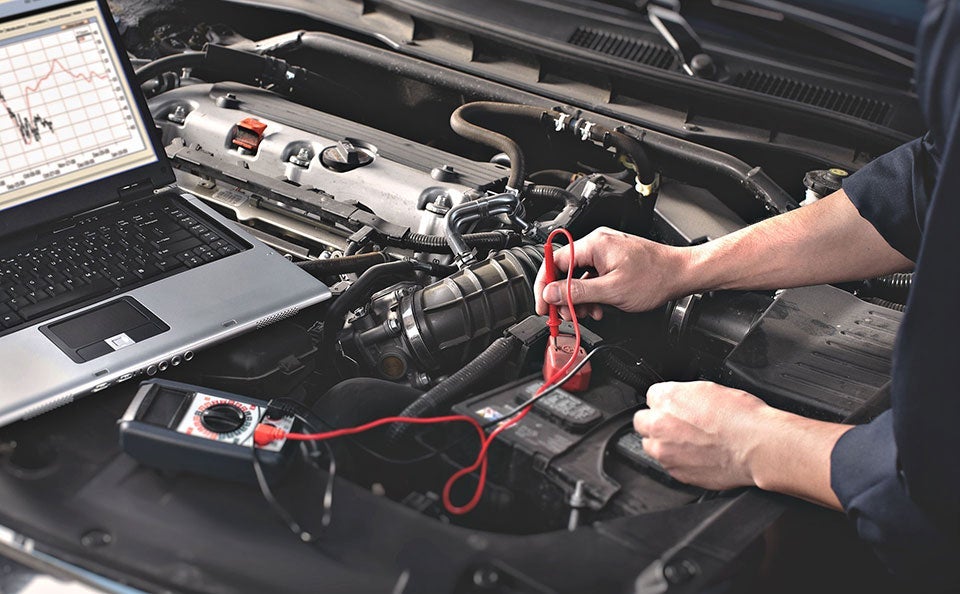
A battery test being done near Pleasanton, TX

7 Signs Your CDJR Vehicle Needs a New Battery

Have you ever been caught off-guard by a dead battery in your CDJR vehicle? Most drivers have been there, but did you know there are warning signs that can help prevent that inconvenient situation? Keep reading as we discuss some common warning signs, so you will know when it's time to visit your CDJR dealer for a new car battery. Repeated Jump-starts If you need to jump-start your car frequently during a short period of time, it's likely your car battery is failing to maintain enough power to start the engine. more Dim Headlights While Idling Pay attention to the strength of your headlights. If they appear dim during idle but brighten when you accelerate, there is a good chance your battery is too weak to send sufficient power to the lighting components. Unpleasant Smell If you notice a sulfuric odor or "rotten egg" smell coming from your car battery, that could mean the battery has a leak. This can happen when the battery has been damaged or overcharged. Long Period of Unuse The adage 'use it or lose it' applies to car batteries. Though a car draws power from the battery, a healthy battery will also charge while the car is being driven. Therefore, not driving your car for an extended time can cause the battery's power supply to deplete. Slow Starting If your car takes a bit longer to start than usual, it could be due to a failing battery. When a car battery becomes low on resources, it can take longer for it to respond to power demands. Sluggish Power Windows Often when a car battery is on the brink of dying, features powered by electrical components, such as power windows, become slow and sluggish when the engine is turned off. Visible Corrosion on Terminals When you look at your car battery, if you notice a chalky white-greenish substance on the battery terminals, it is most likely corrosion. While light corrosion is normal and can usually be cleaned off, excessive corrosion may mean the battery is leaking or damaged. Also, the thick buildup can block the battery from sending power out to components. Being aware of these common signs of a dying car battery can save you from the inconvenience of getting stranded while on the road. If you notice any of the signs mentioned above, visit or contact us at Allways Atascosa CDJR in Pleasanton, TX to have your battery checked and/or replaced.

Person with gloves checking the oil dipstick near Pleasanton, TX

How Often Should Your CDJR Vehicle Get an Oil Change?

One of the most important routine vehicle servicing jobs for any car owner is having the oil changed. If you allow your motor oil to age, diminish, or degrade, the resulting friction could cause overheating that may significantly damage your car's engine. If you're wondering how often to have your motor oil refreshed, here's a brief guide to follow. If you have more questions, you can also contact us at Allways Atascosa CDJR for all your car care needs. Twice a Year Is a Good Rule of Thumb Most drivers can keep their engines perfectly healthy with biannual oil servicing every six months or so. If the engine isn't being taxed by excessive use, severe climate conditions, or extreme driving habits, then this interval should be fine. more It's generally unwise to allow more than 7,500 or 10,000 miles to pass before refreshing motor oil. After this, motor oil can begin to break down and lose its lubricating and cleaning qualities. Check Your Warranty and Owner's Manual Your powertrain warranty typically stipulates a certain interval at which the oil needs to be refreshed. To keep the warranty valid, stick to this recommendation and keep your paperwork to prove your service was addressed at your local dealership. Driving Conditions That Wear Oil Down Faster There are several driving conditions and habits that cause motor oil to degrade more rapidly. If the following apply to you, schedule more frequent oil servicing. In some modern cars, the automatic oil-life monitoring system may help to determine whether your regular driving conditions count as severe. Frequent Short Trips The problem with very short trips in a car is that the motor oil doesn't have time to fully warm up. So, if you're always using your car for short trips of under five miles (or under ten miles during winter), your engine and motor oil are undergoing far more wear and tear than usual. Low Speeds for Long Distances Long drivers at low speeds also put excessive pressure on the engine. It's best for a car to reach certain speeds when traveling further distances. Heavy Stop-and-Go Driving Stop-and-go traffic requires a great deal of idling, which takes a toll on your engine. If your daily commute involves sitting in a lot of traffic jams, consider more frequent oil servicing. Dirty, Sandy, or Dusty Roads Any rough road surface that throws up a good deal of dust, dirt, or sand can also degrade motor oil more quickly. This, typically caused by off-roading, is one of the toughest conditions for motor oil to handle. Extremely Hot or Cold Climates Both excessive heat and cold can lead to motor oil wearing down faster. If you're living in a place with either too much sun or snow, keep a closer eye on the condition of your oil. Schedule Routine Oil Servicing at Your Chrysler Dealer If you set up a suitable scheduled routine for refreshing your oil at your nearest dealership, you'll gain reliable reminders for each upcoming visit. The technicians can also take your regular driving conditions and habits into account when planning the optimal interval between visits. Have your oil checked and changed by experienced technicians today at Allways Atascosa CDJR. We have been proudly serving our local Texas community with top-notch vehicles, deals, financing, maintenance, and repairs for over 20 years.